
Commercial Generator Sizing Calculators
The Caterpillar Power Hub is a centralized resource that helps customers with sizing a commercial generator for their power projects. For smaller, more straightforward projects, the Three Step Sizer serves as an easy-to-use commercial generator sizing calculator. For larger or more complex applications, Cat SpecSizer provides a more detailed option to evaluate project requirements and identify the right power solution.
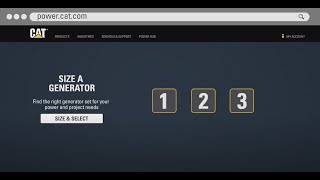
Size with the Three Step Sizer
- Ideal for smaller projects—up to 25 loads in one to five different load steps
- Find the size you need with this mobile-friendly tool in three short steps
- Match sizing output need with available diesel and gas generator set inventory
- Ability to save your project for future reference
- Download configuration specific 2D & 3D drawings
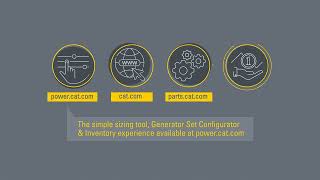
Size with SpecSizer
- Ideal for complex or large projects—no limit on number of loads or steps
- Provides calculated voltage and frequency dips
- Add loads via multiple methods—individually, multiple loads at once, spreadsheet upload
- Ability to save and share your project with other users
- Ability to download and create guide specifications
- Size stationary and mobile generator sets
What size standby generator do I need?
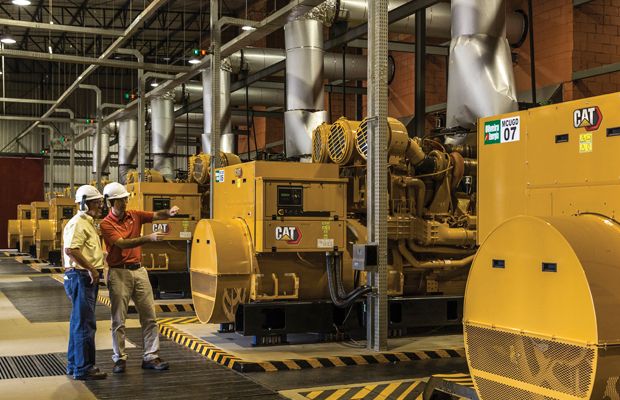
You can determine what size generator set you need by using one of our online generator set sizing calculators. Our generator set sizing calculators determine the total electrical load your system needs to support, including both running demand and higher starting (surge) demands from equipment like motors or HVAC units. Key factors that impact generator set size include the quantity and type of appliances, peak vs. continuous usage, voltage requirements, and whether loads are managed as intermittent to cycle on/off. Environmental conditions, such as temperature and altitude which may derate a generator set rating, and future expansion plans can also influence the recommended capacity. Accurately sizing a standby generator set ensures it can handle startup surges without overloading or shutting down. If the generator set is too small, it may fail during critical moments, while an oversized set can increase costs, reduce efficiency, and possibly cause engine wet stacking if 30% or less capacity used.
How the commercial generator sizing calculator works?
Our commercial generator set sizing calculators work by estimating total electrical kW and kVA demand based on user-provided inputs about the facility loads and operations.
When sizing a commercial generator set, our calculators need a set of electrical load details to determine the required inrush and running kW and kVA demand. The key inputs users provide are load type (e.g., HVAC units, pumps, lighting, motors), output rating, and starting method where applicable. The calculators then determine load requirements by combining running demand with step and peak demand starting requirements, applying diversity factors to reflect how equipment operates in real-world conditions. This process helps simulate realistic power requirements rather than simply adding maximum values together.
After sizing computations have completed, the calculators recommend a generator set model and rating (kW/kVA) and suggest applicable generator set types or configurations based on the results.
The calculators recommended best fit generator set is only as accurate as the information provided by the user. In addition, sizing calculators rely on site assumptions about typical usage patterns, standard equipment loads, and simplified operating conditions. They may not fully account for unique site factors like harmonics, power factor variations, or future expansion, so results should be validated by an engineer for critical applications.
Commercial generator sizing calculator: Use cases
Our commercial generator set sizing calculators are designed for a range of users who need to quickly estimate power requirements across different environments.
- Electrical contractors can use our sizing calculators during early project planning to determine the appropriate generator set before detailed engineering takes place.
- Facility managers planning backup power can rely on our sizing calculators to assess critical loads and maintain operations during outages.
- Business owners who are evaluating standby power needs find our sizing calculators valuable when they want a clearer picture of potential system size and cost implications.
- Additionally, our sizing calculators support emergency preparedness planning by helping organizations understand what level of power is required to keep essential systems running. When sizing a commercial generator set, our calculators can provide a practical starting point for decision-making before moving on to more detailed design and validation.
Step-by-step guide to sizing a commercial generator
We offer two commercial generator set sizing calculators. Choose the one that fits your project complexity.
Three Step Sizer
This sizing calculator is designed for speed and simplicity and is ideal for early-stage planning, ballpark sizing, or budgetary estimates.
- Step 1: Define Your Power Needs
- Select the application type and fuel type
- Define the electrical supply (duty type, phase, frequency, and voltage)
- Adjust the site conditions (max ambient temp, altitude, and humidity)
- Select Load Types
- Step 2: Define the Electrical Loads
- Provide ratings, steps, and quantities for each load
- Optionally include additional details such as frequency dip and voltage dip
- Step 3: Get Result
- Review the recommended generator set
- Optionally add spare capacity, save your sizing, download your sizing report, or share your sizing with your local dealer
- View matching available inventory or configure your own generator set
SpecSizer
This calculator can be utilized for both simple and large projects, and it excels at handling complex projects with many loads and load types. This calculator is ideal for final engineering design, critical applications (e.g., hospitals, data centers), and projects with significant motor loads.
- Step 1: Create a New Project and Define Your Power Needs
- Determine if the project will be 3-phase or single phase
- Provide project details (customer name, project name, and installation region)
- Identify your engine requirements (application type, duty type, fuel type, emissions certification, expansion capacity, and maximum loading)
- Set the site conditions (maximum ambient temp, altitude, and humidity)
- Define the electrical supply (frequency, voltage, maximum temp rise/ambient temp, and UL listed)
- Select Load Types
- Step 2: Define the Electrical Loads
- Provide ratings, steps, and quantities for each load
- Optionally include additional details such as load name, frequency dip, voltage dip, and load shedding
- Step 3: Select Generator Set
- Review details of the recommended generator set
- View and compare additional products and configurations
- Select your ideal generator set
- Step 4: Utilize Engine Room Tools
- Optionally utilize additional tools to calculate fuel need, exhaust back pressure, radiator duct and louver designer, and foundation block sizing.
- Step 5: Download Data and Reports
- Save your sizing, download your sizing report, or download drawings and spec sheets for the selected generator set
- Step 6: Share Your Project
- Optionally share your project with other users or your local dealer
Common mistakes when determining what size standby generator you need
- One of the most common mistakes when sizing a commercial generator set is underestimating peak load. Many users rely only on running kW and kVA demand and forget to account for temporary spikes in demand when systems start up or cycle on simultaneously. A commercial generator set sizing calculator helps estimate these peaks, but if inputs are incomplete or overly simplified, the result can still fall short leading to overloads or unexpected shutdowns during critical moments.
- Another frequent issue is ignoring future growth. Businesses often size a generator set based solely on current needs without considering future expansion, additional equipment, or increased operational demand. This can quickly render a system undersized, requiring costly upgrades or replacements. Using a commercial generator set sizing calculator as a planning tool, rather than a fixed answer, can help account for scalability and long-term requirements.
- Overlooking motor starting requirements is also a key error, particularly in facilities with HVAC systems, pumps, or heavy machinery. These loads can require significantly higher starting current than their normal operating levels, which must be factored into generator set capacity. Without properly accounting for these surges when sizing a commercial generator set, even a unit that seems adequate on paper may fail to perform reliably in real-world conditions.
- Finally, choosing a generator set based primarily on upfront cost instead of capacity can lead to poor outcomes. While a smaller generator set may seem more affordable initially, it may not deliver the reliability or performance needed during an outage. A properly used commercial generator set sizing calculator helps balance cost with performance by identifying the minimum capacity required to maintain critical operations without compromise.
Explore related commercial gas generator resources






Your Business
 North America – English
Caterpillar Brands
- Caterpillar.com
- Contact Us
- My Marketing Preferences
- Site Map
- Cookie Settings
- Legal
- Privacy
- Do Not Sell or Share My Personal Information
- Accessibility Statement
- US-English
- © 2026 Caterpillar. All Rights Reserved.