
How Remanufacturing Supports Lower OpEx and Sustainability Initiatives in the Oilfield
Products for Oil & Gas
Parts & Services
Sustainability
About
Optimizing costs remains a key priority for all oilfield companies. However, evolving industry requirements concerning greenhouse gas (GHG) emissions levels can prove challenging as cost-reduction strategies often compete with companies’ sustainability objectives. Fortunately, advancements in remanufacturing helps enable companies to lower costs and reduce waste while maintaining dependable quality and performance.
A Strategic Approach to Protecting Capital and Uptime
Cat® Reman serves as a pivotal lever that supports capital discipline and operational initiatives. Remanufactured parts and engines enable oilfield companies to not only save CapEx with solutions offered at 45-85% of the cost of new with the return of the used core but also receive a same-as-new 12-month limited warranty1. This enables operators to experience like-new performance at a fraction of the traditional cost.
Incorporating remanufactured parts and equipment into an operational strategy is a reliable way to enhance uptime as well. Cat Reman’s extensive stock provides convenient and quick access to spares and complete engine assemblies, enabling operators to minimize on-hand parts inventories. Ultimately, optimizing component reserves helps further improve cash flow flexibility to fund strategic growth initiatives.
Understanding the Cat Reman Process
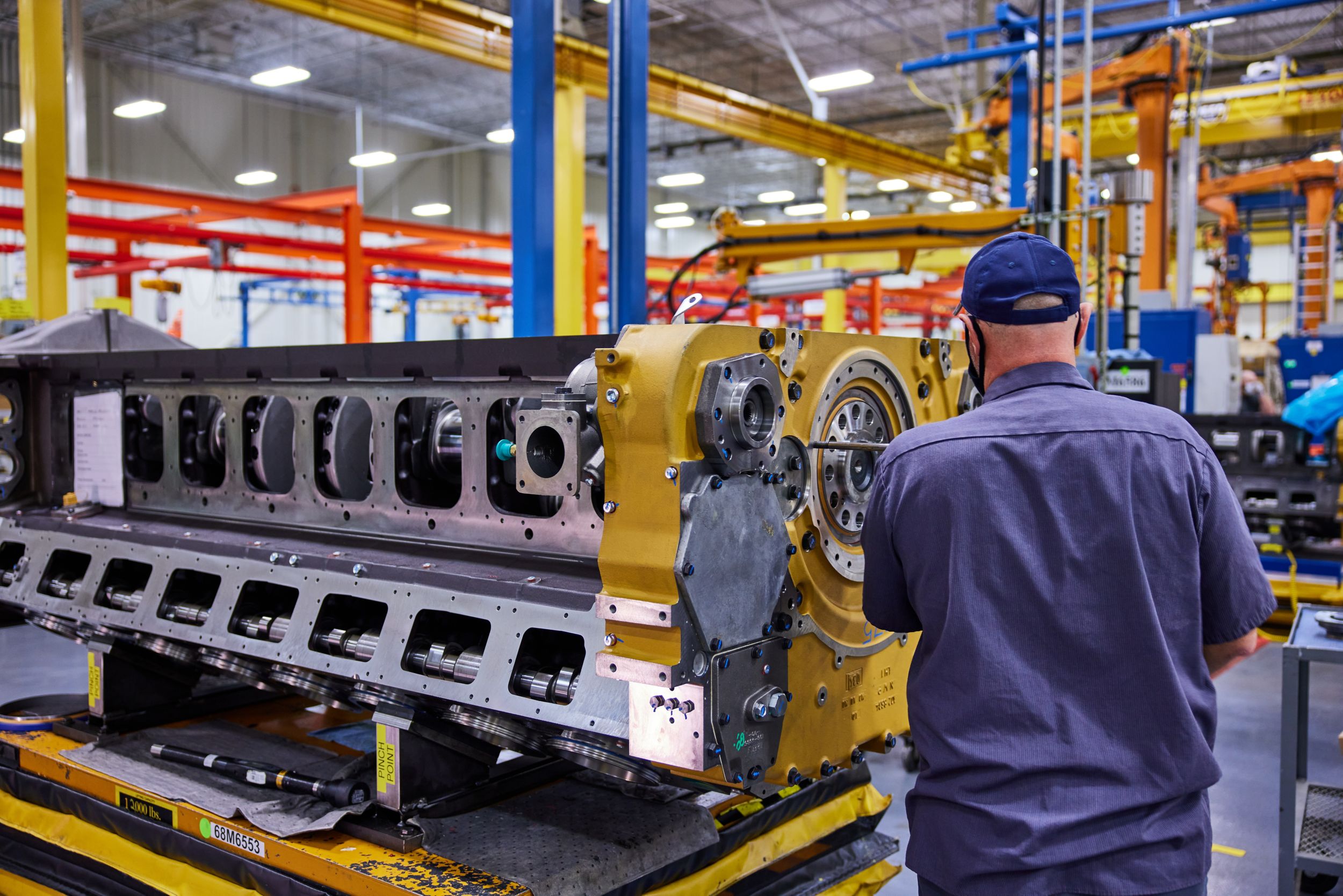
Cat Reman’s approach uses a combination of salvaged and new parts to return an end-of-life product to its original quality and performance specifications. Returned parts are disassembled, cleaned and inspected before undergoing processes such as laser cladding, machining, metal deposition and other advanced salvage procedures.
Aqueous, mechanical or thermal cleaning processes may be used. Aqueous cleaning combines water and chemistry applications, often using equipment such as immersion tanks, cabinet washers, ultrasonics and flush stations. Mechanical cleaning uses physical force with equipment that can include dry blast, slurry blast, high-pressure blast and vibratory bowls. Thermal cleaning uses high heat but can also include a secondary cleaning with salt baths, fluidized beds and ovens. The remanufactured parts are then assembled into components with like-new quality that incorporate current engineering updates.
of
Curbing Raw Material and Energy Use to Support Operational and Sustainability Initiatives
Utilizing remanufactured components and complete drop-in land drilling engines is a practical way for operators to preserve budgets, improve parts availability and support sustainability objectives while maintaining a high level of performance. This philosophy supports the circular economy concept of keeping materials in use for as long as possible to extract maximum value with minimal process energy.
In 2025 alone, Caterpillar collected 150 million pounds of material through end-of-life returns2. That level of recovery extends the life of components and keeps materials in circulation, minimizes waste and conserves raw materials which subsequently reduces the environmental impact of extraction and processing. Remanufacturing can also reduce resource strain and potentially mitigate the risk involved with sourcing scarce materials – using 80-90% less raw material by weight3.
Remanufacturing not only holistically promotes lower GHG emissions compared to manufacturing new components but also reduces part costs due to requiring less energy. It’s reported that remanufacturing results in 65-87% less process energy4 and process GHG emissions when compared to manufacturing new parts. As an example, a Cat Certified Rebuild machine reduces Scope 3 GHG emissions by a minimum of 70% when compared to buying an equivalent new machine5.
For many oilfield companies, relying on remanufactured parts and engines is a proven pathway to experience enhanced operational efficiency while aligning with emerging industry requirements.
1. Cat.com. The Cat® Reman Difference. https://www.cat.com/en_US/products/new/parts/reman/the-cat-reman-difference.html
2. Caterpillar.com. 2025 Sustainability Report https://www.caterpillar.com/en/company/sustainability/sustainability-report.html.
3. OnePlanetNetwork.org. Redefining Value: The Manufacturing Revolution - Remanufacturing, Refurbishment, Repair and Direct Reuse in the Circular Economy. https://www.oneplanetnetwork.org/sites/default/files/from-crm/re-defining_value-_the_manufacturing_revolution_summary_industry_english_web.pdf.
4. OnePlanetNetwork.org. Redefining Value: The Manufacturing Revolution - Remanufacturing, Refurbishment, Repair and Direct Reuse in the Circular Economy. https://www.oneplanetnetwork.org/sites/default/files/from-crm/re-defining_value-_the_manufacturing_revolution_summary_industry_english_web.pdf.
5. Caterpillar.com. 2025 Sustainability Report. https://www.caterpillar.com/en/company/sustainability/sustainability-report.html.
Your Business
 North America – English

Caterpillar Brands
- Caterpillar.com
- Contact Us
- My Marketing Preferences
- Site Map
- Cookie Settings
- Legal
- Privacy
- Do Not Sell or Share My Personal Information
- Accessibility Statement
- US-English
- © 2026 Caterpillar. All Rights Reserved.