

Delivering Excellence: Energy, Data and Savings
A Day In The Life At The Cat® AMP Command Center

What do thousands of data points, one very busy power grid and an endless supply of sourdough pretzel nuggets have in common? They’re all part of a typical day for Claire Gramlich.
A civil engineer by degree, Claire discovered a love for energy during an internship at PJM, one of the nation’s largest grid operators. Twelve years later, she’s manager of the Cat® AMP Command Center, leading the team that monitors and manages 7,200 megawatts of distributed energy assets at 6,600 customer sites across North America.
Cat AMP is Caterpillar's Distributed Energy Resource Management System (DERMS) designed to help you take control of your energy strategy. By intelligently dispatching on-site power generation assets, Cat AMP reduces grid demand during peak periods, when energy is most expensive or when utility billing rates are being set. Behind the scenes, Claire and the command center team monitor and manage your assets to ensure they're ready to perform as needed — keeping your operations efficient and reliable while helping you realize the full savings potential of your energy strategy.
With extreme weather, unpredictable demand and power equipment spread across four time zones, it’s hard to call any day “typical.” But to get a sense of how Claire and her team keep power flowing — and costs down — for Cat AMP customers, here’s a look at one record-hot July day last summer.
7:00 A.M.: Starting The Day With Data…And A Plan
As first shift clocks in, the Command Center is already abuzz with activity. Claire reviewed Cat AMP alerts from home and did a quick check on the weather, jotting down a running timeline for the day in the notebook she keeps close at hand. Fresh operators overlap with the third-shift crew for a handoff, scanning overnight reports and checking any active alarms. The goal: catch small issues before they turn into big ones.
“An alert came in overnight about low coolant on a generator,” Claire says. “We’re dispatching a technician right now, so if that unit’s called on to run today, it’ll be ready.”
Beyond troubleshooting, much of the morning revolves around operations and maintenance administration. Multiple assets are scheduled for planned service today, so operators stay in contact with technicians on site — updating logs in real time and keeping both the customer and the tech aligned on what’s happening.
9:40 A.M.: Reading The Grid In Real Time
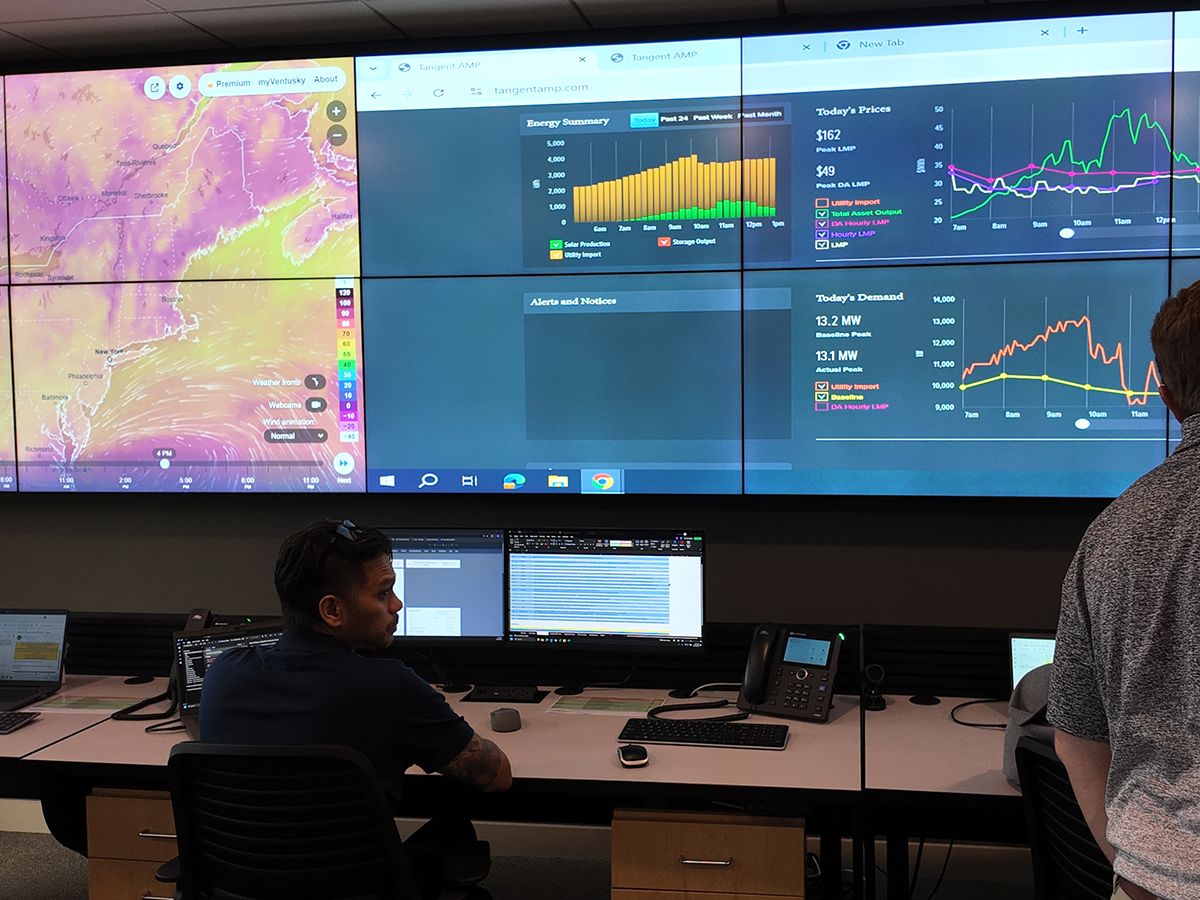
Rows of screens fill the Command Center, tracking grid loads, forecasts and pricing in real time. Operators scan for early warning signs: a spike in demand, a sudden price jump, a brief loss of communication. At her desk, Claire flips between independent system operators (ISOs) and regional transmission operators (RTOs) across the U.S. and Canada, watching an early price surge take shape in the Mid-Atlantic region.
A dispatch signal comes through: several customers are being called to participate in a demand-response event. Within seconds, Cat AMP starts the assets automatically, and operators verify that every site expected to run is online and earning the value it should. Often, they have just 10 minutes to confirm participation before the window closes.
“We watch trends and data in real time,” Claire says. “Cat AMP does a great job, but there’s still intuition — gut feelings — you get after working in this industry so long. It’s not all about algorithms. You need the human touch, too.”
That instinct helps her anticipate what software can’t always predict. On a sunny summer Friday, when offices empty early and factory shifts wind down ahead of the weekend, she knows the peak may hit sooner than models suggest.
11:30 A.M.: Teaching The Art Behind The Software
Once or twice a month, Claire gathers her team for training. Today’s topic: economic dispatch priorities. On the big screen, she reviews how Cat AMP’s algorithms determine the best times to run distributed assets:
- Helps customers avoid high-cost hours, which would increase their annual bill
- Bids customer's assets into energy programs so they get new revenue streams
- Gives customers the ability to participate in utility ran programs that pay for their grid support
“Each customer’s value stack looks a little different,” Claire says. “We work with them to identify which strategies matter most, build that into the software and let Cat AMP optimize dispatch from there. The result is lower electric bills and often new revenue from market participation.”
Still, she reminds the team that human oversight is what turns optimization into real value.
“Cat AMP optimizes based on the data it sees, but sometimes we can catch an opportunity sooner,” she says. “It’s our job to make sure every asset is performing like it should — and to step in manually when it makes sense.”
2:45 P.M.: Delivering Under Pressure
Outside, temperatures push toward triple digits. Inside, the Command Center shifts into high gear. Claire increased staffing for the afternoon days ago, after spotting this heatwave in the forecast. She and her team also coordinated with Cat dealers across the Northeast to make sure every asset under contract was serviced and ready to run.
That preparation pays off when a red alert suddenly flashes across one of the dashboards. A customer’s generator — part of a large manufacturing complex — has tripped offline in the middle of rolling brownouts.
Minutes later, Claire is on the phone with the facility manager. Working together, they confirm the cause: not an engine fault but a grid disturbance upstream. Twenty minutes later, the generator is reset and running again — just in time for the site to avoid that afternoon’s peaks.
The quick recovery saves the customer an estimated $250,000 per megawatt.
5:10 P.M.: Handing Off The Watch
Late afternoon light spills across the monitors as Claire wraps up her notes for the next shift: tasks logged, events recorded, everything in order for the evening crew. On her desk sits the telltale sign of a busy day.
“My team knows, if they walk into my office and the sourdough pretzel nuggets are out, it’s been a day,” she says. “In the summer, it feels like there’s a constantly revolving bag on my desk.”
Before heading out, Claire checks in with the second-shift operators coming on duty, then gathers her notebook and steps into the lingering heat — confident her team will keep things steady through the night.
9:15 P.M.: Unwinding But Never Off Duty
After dinner and quality time with her three kids, Claire touches base one last time with the overnight crew. Load curves are flattening, no new alarms are pinging and tomorrow’s weather looks cooler: a welcome sign.
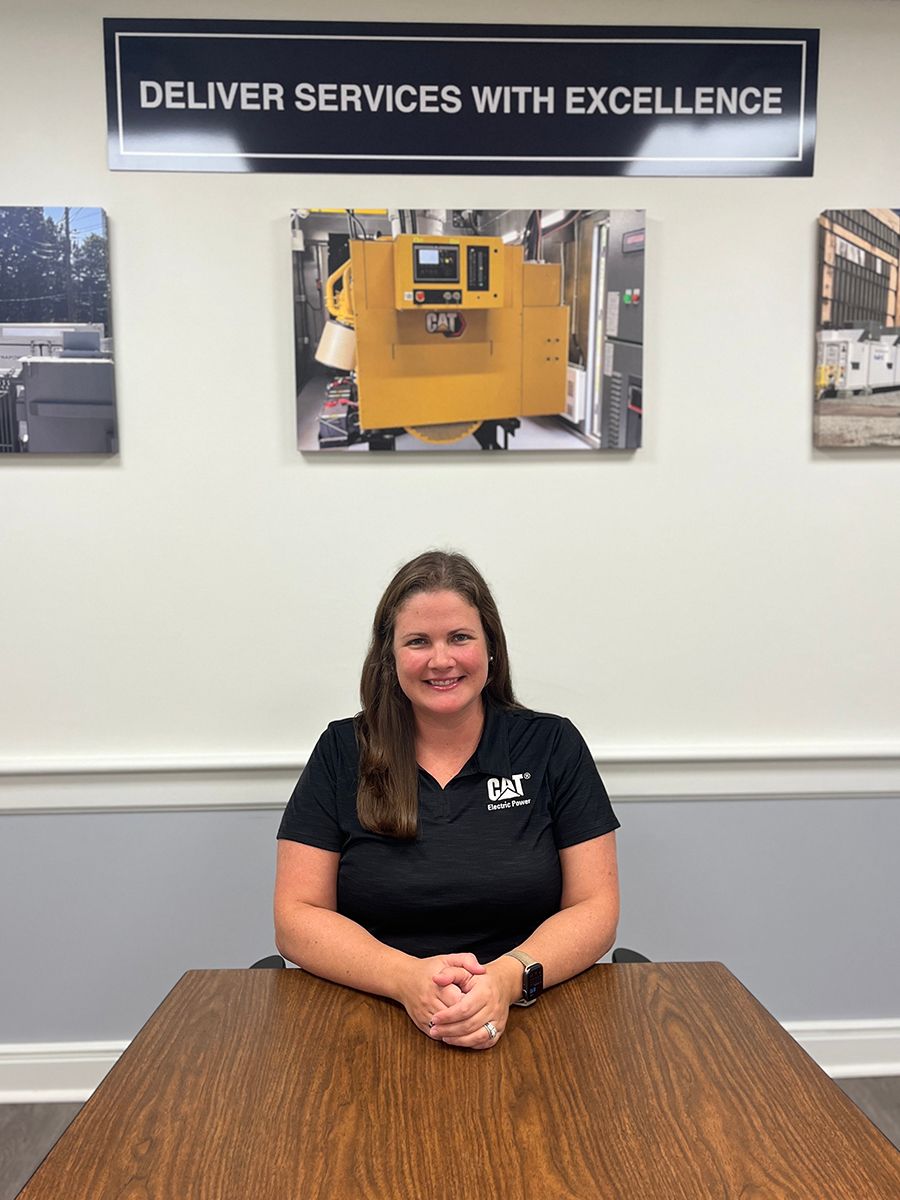
She flips her notebook shut but can’t help thinking about the Command Center’s mantra, now posted above the operators’ desks: Deliver services with excellence.
“It’s more than a slogan,” she says. “We pride ourselves on going over and above what’s in a contract to make sure our customers’ assets are ready to run when called upon and ready to save or make them money.”
In a world full of automated alerts and algorithms, it’s people like Claire — fueled by experience, instinct and maybe a few too many sourdough pretzel nuggets — who keep the power flowing.
Want to learn how Claire and her team at the Cat AMP Command Center can help you optimize your distributed energy assets, cut energy costs and stay ready for the next grid event? Get in touch with our experts today.
Claire Gramlich
Manager, Operations Center
Claire has been in the energy industry for more than 12 years and currently manages Cat AMP's 24/7 Network Operations Center, which monitors more than 6,600 MWs of customer load, including over 175MW of installed distributed energy resources. Her key responsibilities include leading the Operations Center, which includes DER asset management and asset dispatch, as well as the regulatory and account management teams. She is also integral in steering design, development, and support of the Cat AMP system.
Claire has expertise in energy markets, fleet management, and customer and investor support. Prior to Cat AMP, Claire worked for PJM Interconnection within their EIS group.
Related Blogs
-
Reliability and Resiliency: How Co-ops Can Achieve Both with Distributed Energy Resources
See how distributed energy resources and DERMS help co-ops build affordable grid reliability, resilience, and disaster preparedness.
Learn More -
How Municipal Utilities Can Address Surging Power Demand
For many municipal utility managers I talk to, it’s getting tougher to continue providing the highest levels of reliability, service, and value. Customer preferences are changing. Some want 100% renewable power overnight; others simply care about cost. Other challenges are mounting, too: New technologies. Increased regulation. Workforce shortages. Budget constraints. And perhaps biggest of all, rising demand.
Learn More -
5 Steps to Sign-Off on a New Energy Solution
You’re a large energy consumer, maybe in healthcare, education, distribution or transportation. You’re facing pressure — internal, external or both — to increase your energy resiliency, lower your carbon emissions, reduce your energy costs, add capacity for expansion, or some combination of all four. You know you need to act (and soon), but you’re struggling with how to get started implementing a solution.
Learn More -
Is Your Organization a Good Fit for EaaS? And Is Your EaaS Partner a Good Fit for You?
Our EaaS team at Caterpillar has implemented solutions for all types of operations: from K-12 schools and grocery stores to industrial facilities. The concept — you purchase energy outcomes and turn ownership and upkeep of energy assets over to a third party — works for many organizations. How do you know if yours is one of them?
Learn More



Your Business
 North America – English
Caterpillar Brands
- Caterpillar.com
- Contact Us
- My Marketing Preferences
- Site Map
- Cookie Settings
- Legal
- Privacy
- Do Not Sell or Share My Personal Information
- Accessibility Statement
- US-English
- © 2026 Caterpillar. All Rights Reserved.