
Faster Response, Smaller Footprint:
The Gearbox Advantage in 50 Hz Generator Applications
Casey P. Mast
Engineering Project Team Leader
Large Power Systems Division
Loris Buess
Senior Account Manager
Electric Power Division
ABSTRACT
As the energy landscape shifts, it becomes increasingly important for facilities to have reliable and economical sources of power they control. This is especially true for hospitals, factories, data centers, airports, and other facilities where power availability and stability are critical. Diesel standby generation is still a popular choice for many businesses and communities as they are known to be responsive and flexible, meaning they can adapt to changing power needs demanded from the site.
However, local power regulations in 50 Hz countries have introduced challenges for diesel generator performance. These regulations require that 4-pole alternators operate at 1500 rpm, a speed that can influence how a generator set delivers its expected benefits. For businesses relying on standby power, this matters because operating outside optimal conditions may affect efficiency, fuel consumption, and long-term equipment health.
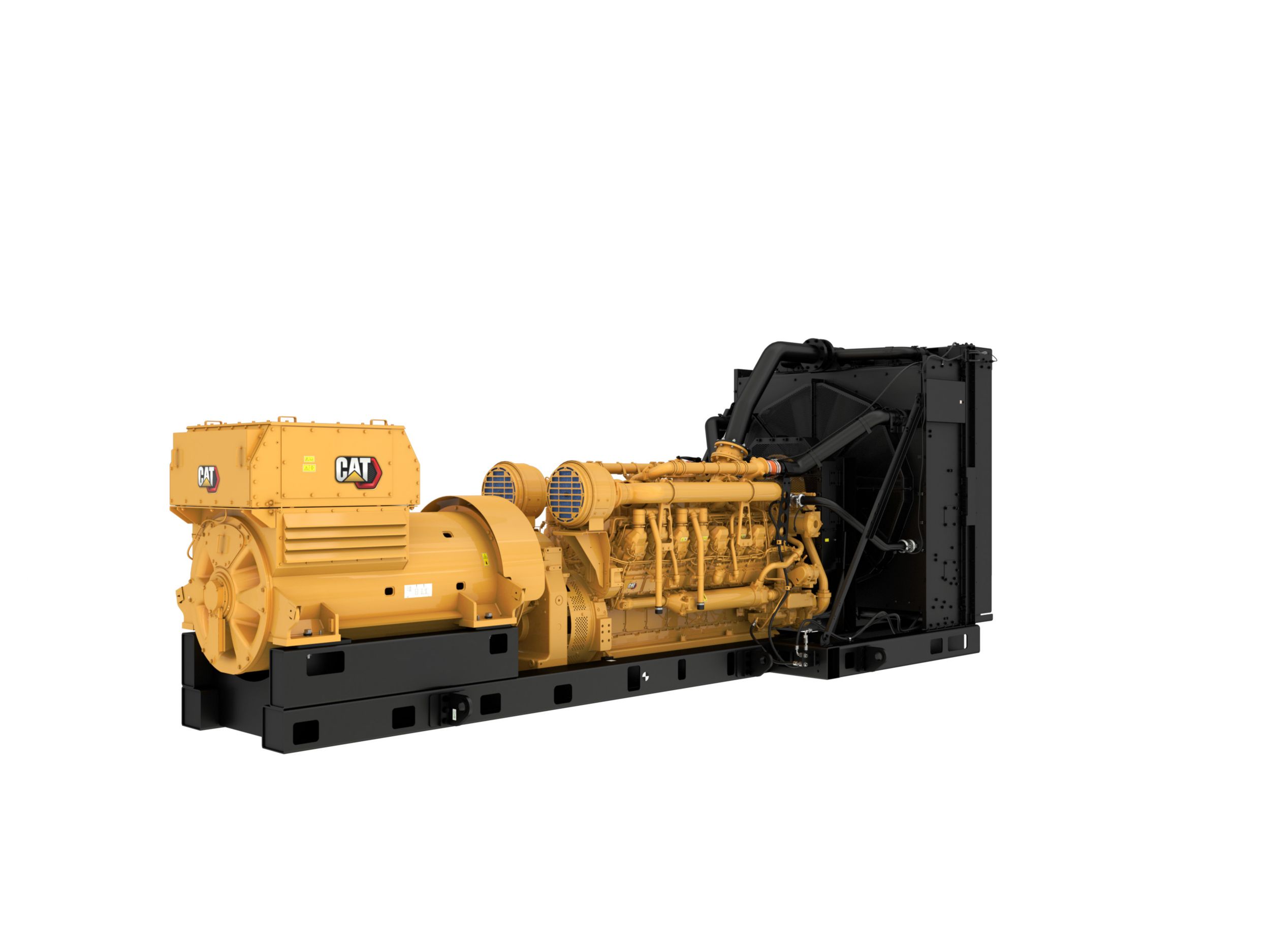
To address this, Caterpillar developed a close-coupled gearbox technology that allows the diesel engine to run at 1800 rpm while the generator continues at 1500 rpm to meet 50 Hz requirements. This approach helps improve transient response and maintain power density without increasing footprint.
In this white paper, we’ll explain why this technology matters, how it works, and what benefits it delivers for businesses operating in 50 Hz regions. We’ll also outline the types of applications and requirements where gearbox technology is most suitable, so you can determine the best fit for your needs.
How Can Gearbox Technology Solve the Problems?
A close-coupled gearbox uses technology much like the transmission in a vehicle and fulfills a similar role: it disassociates the engine driving speed from the speed of the driven equipment (in this case: generator).
The main benefit of the gearbox is simple: it allows the engine to run at a higher speed (typically 1800 rpm) while driving an alternator at a slower speed, typically 1500 rpm as dictated by the 50 Hz power grid. In turn, this increases power density and improves transient response.
Increased Power Density
Diesel generator set engines running at 1800 rpm will produce more power than at 1500 rpm, delivering greater power density from a given engine displacement. For example, these are the power ratings of two large Cat® diesel generator sets at differing speeds:
3516E
1800 rpm 3000 ekW
1500 rpm 2800 ekW
C32B
1800 rpm 1500 ekW
1500 rpm 1340 ekW
The faster speed allows an increase in the number of cylinders that can fire within a given time period, ultimately providing more energy in the same amount of time.
Improved Transient Response
In addition to the greater overall power, the physical rotating system can store and release greater amounts of kinetic energy if the engine is running at a higher speed. High rotational energy (ERotational) is crucial for minimizing voltage dip, frequency dip, and response time. The limit to the amount of energy stored in a system is functionally related to its rotational speed (angular velocity).
As the angular velocity (represented by ω,or omega) increases, the energy stored in the system increases proportionally to the square of the speed ratio. In the following equation, I represents the moment of inertia of the rotating system, which remains constant between 1500 rpm and 1800 rpm. Therefore, the change in energy is driven entirely by the increase in angular velocity.
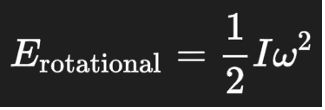
Increasing from 1500 rpm to 1800 rpm gives us an increased speed ratio of 1.2. When squared, this results in a factor of 1.44, or a 44% increase in stored energy.
(1800 rpm / 1500 rpm) ^2 = 1.44 = 44% Increase in stored energy.
This increase in stored energy allows the engine speed to remain higher as load is applied, thus giving the engine a fueling advantage to maintain its speed, and adjust to loads at a faster rate.
In a standby application, this load ramping and stepping advantage can translate to millions of dollars in savings, not only because of superior up-time for the customers, but also allowing in facility planning allowing designers to right-size their Uninterruptible Power Supplies (UPS’s) from the beginning.
These benefits are important but are not the only benefits a gearbox provides.
What are the Benefits of a Generator Set Gearbox?
Let’s review the benefits of the gearbox technology and how it effectively meets operational needs, while also offering several additional advantages.
A Gearbox Generator Set Delivers More Power
Operating at 1800 rpm engine speed delivers more power. With a gearbox, you can effectively deliver previously unachievable 50 Hz power without increasing engine displacement.
A Gearbox Generator Set Has Improved Transient Response
With the greater rotational energy provided by a faster engine and a gearbox, you’ll see less voltage dip, less frequency dip, and faster load acceptance.
A Gearbox Generator Set Has a Reduced Footprint
It may seem odd for a generator set with added equipment to take up less space, but a generator set equipped with a Caterpillar designed close-coupled gearbox reduces the potential footprint in two ways.
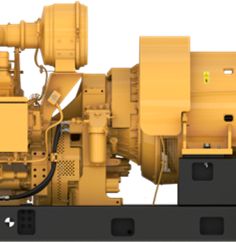
First, the new gearbox design takes up less space. Rather than being attached to the generator set rail, the new gearbox is rigidly bolted to the engine and alternator, creating a single, integrated unit. This arrangement reduces the generator set length as demonstrated by the figure to the right.
Second, the small increase in overall length is far outweighed by the power increase. If we compare footprints of two equally-performing standby Cat 50Hz generator sets, the gearbox generator set advantages set it apart.
A Gearbox Generator Set Has the Same Serviceability as Traditional, Non-Gearbox Models
The new close-coupled gearbox creates a platform that runs like a standard generator set and is easily maintained. The alignment procedure for Cat gearbox generator sets now closely replicates the standard single- and two-bearing generator set alignment procedures. The gearbox oil cooler can be installed in the radiator, eliminating the need for a separate cooling fan and electric motor.
The gearbox design is also extremely reliable, with 85% of its parts leveraged from and common with Cat construction and mining equipment. And as always, Cat generator set gearboxes are rigorously tested and validated under both application-specific and worse case loading conditions including thousands of hours of field endurance.
Gearbox Technology Allows Use of the Same Platform Across Regions
For large, multi-national businesses, separate, site-specific power solutions are often needed, based on their site locations within 50 Hz or 60 Hz power regions. The use of Cat gearbox generator sets can greatly simplify this, as customers can commonize their power fleet on a single engine platform and power node across the entire world, for both 50 and 60 Hz:
- an engine with a traditional generator set for 60 Hz
- the same engine with a gearbox generator set for 50 Hz
This can simplify and streamline maintenance, inventory stocking, and technician training.
Should You Use a Diesel-Powered Gearbox Generator Set?
Planning power equipment installations for your facility involves a number of complex technical decisions, but deciding whether to employ a gearbox generator set is as simple as prioritizing your most important requirements.
If high power density and excellent transient response are needed, you will be well-served by a diesel-powered generator set operating at high speed and equipped with a close-coupled gearbox. However, if you have the possibility to smoothen your load profile over a few minutes rather than seconds, and want to benefit from an optimized footprint and compact solution, then a high-power generator set operating at the traditional 1500 rpm with no gearbox will probably be the best unit for your purpose.
If you need help with determining the best option for you, your local Cat dealer can assist you in this decision.
Conclusion
To tackle the challenge of meeting 50 Hz requirements while maintaining performance, adding a gearbox to a diesel generator set can help facilities and businesses overcome these limitations and secure a reliable standby power solution. Additional benefits of choosing a gearbox-equipped generator set include higher power density, excellent transient response, and minimal space claim.

Products
Services & Support
How Can We Help?
News
Connect with Cat
 Southeast Asia ‧ English
Caterpillar Brands
- Caterpillar.com
- Contact Us
- My Marketing Preferences
- Site Map
- Cookie Settings
- Legal
- Privacy
- Do Not Sell or Share My Personal Information
- Southeast Asia-English
- © 2026 Caterpillar. All Rights Reserved.